Playing guitar and bass with my son
Fine alone, a mess together
This happened while I was helping my son with his practice. The song we picked was Green Day's Basket Case, and we decided to play it together on electric guitar and bass.
On our own, there was no problem. Each part got through the song from start to finish without trouble, so I assumed playing together would come easily.
It didn't. When we played together, the balance was a mess. It was hard to point to a single wrong note, but the two instruments refused to sound like one song.
I thought, 'We were both fine separately. Why does it fall apart the moment we play together?'
The problem was two different private beats
Looking back, the reason was simple. My son hadn't really been using a metronome when he practised. When you play alone, your own internal beat is the only reference, so if you drift a little faster or slower you rarely notice. There are no wrong notes, so it sounds like a good take.
Playing together is different. If two people each bring their own private beat, the difference shows up straight away as two parts that don't line up. In a punk song like Basket Case, where eighth notes drive through almost the whole time, the guitar's downstrokes and the bass's eighth notes need to land in the same place for the song to sound tight. If either one is slightly ahead, the sound smears, and the listener hears it as the balance being off.
So I told him, "From now on, practise with the metronome on."
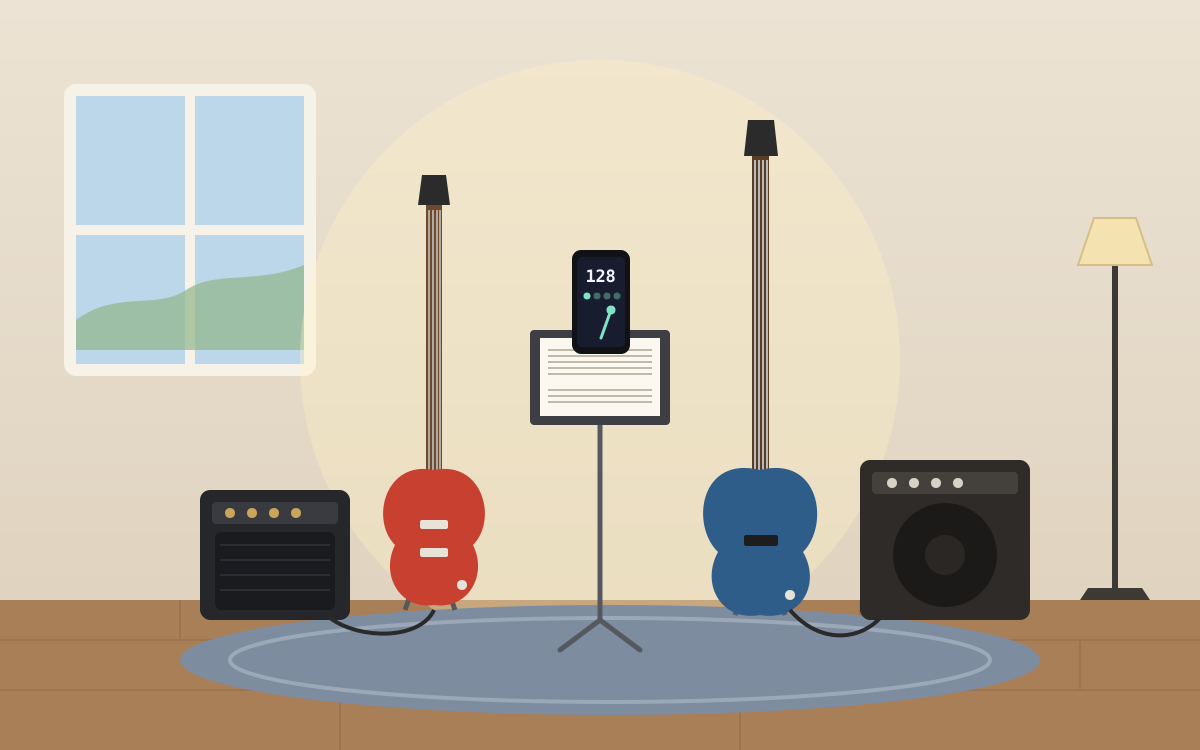
Locking in together at 128 BPM
We practised it at 128 BPM. The point was to stop following our own beats and listen to the same click together. Once we shared a reference, it became much easier to hear who was rushing and who was dragging.
Here are some ways a guitarist and a bassist can use a metronome to lock in. They may help if, like us, you are playing a song as a duo at home with family or a friend.
Lock to the click on your own first
Turning the metronome on for the first time at the rehearsal is too late. Each player should already be practising to a click at the same tempo. Sounding fine alone and sounding fine with a click are not the same thing, so check that you can get through the whole song at 128 with the click before you play together.
Use eighth-note subdivision for the downstrokes
For songs built on constant eighth notes, set the subdivision to eighths. The click then sounds twice per beat, so you can check that every guitar downstroke and every bass note sits right on it. Fast eighth notes tend to run away from you, and the subdivided click holds them in place.
Make sure the click cuts through the amps
With an electric guitar and a bass both coming through amps, a phone's click gets buried quickly. A sharp tone like the digital beep is easier to hear, and if you still can't hear it, turn the amps down first. A click you can't hear is no use at all.
Record yourselves and listen back
Record a run-through on a phone and listen together. Slips you couldn't feel while playing are easy to hear afterwards, and measuring the recording with Tap BPM shows you where the tempo crept up or sagged.
What I learned: the metronome is a must
My conclusion from this is simple. A metronome isn't a nice extra. It's essential.
"I'm fine when I play alone" only means you are fine against your own beat. To fit your playing with someone else's, you both need an outside reference to lean on, and the metronome is what builds that reference into your hands while you practise.
If your child rarely uses a metronome when practising alone, try having them play with someone. Problems that stay hidden in solo practice show up the moment two people play together, and for us that was the clearest way to explain why the metronome needs to be on.
If you are getting ready to play as a guitar and bass duo
- Sounding fine alone doesn't guarantee sounding tight together, because each player's internal beat is slightly different.
- Before you play together, each of you should get through the whole song with a click at the same tempo.
- For songs built on eighth notes, set the subdivision to eighths and put every pick stroke on the click.
- Choose a click tone that cuts through the amps, and adjust the volumes so you can hear it.
- Record the run-through, listen together and use Tap BPM to find where the tempo moved.
Read next
-
Tempo markings and BPM
Andante is a character, not a number. Here is how to turn it into one anyway.
Read the guide -
How to practise slowly with a metronome
Slow practice is not the easy version of fast practice. It is a different skill.
Read the guide -
How to practise polyrhythms
Counting two pulses at once rarely works. Count the one grid they share.
Read the guide